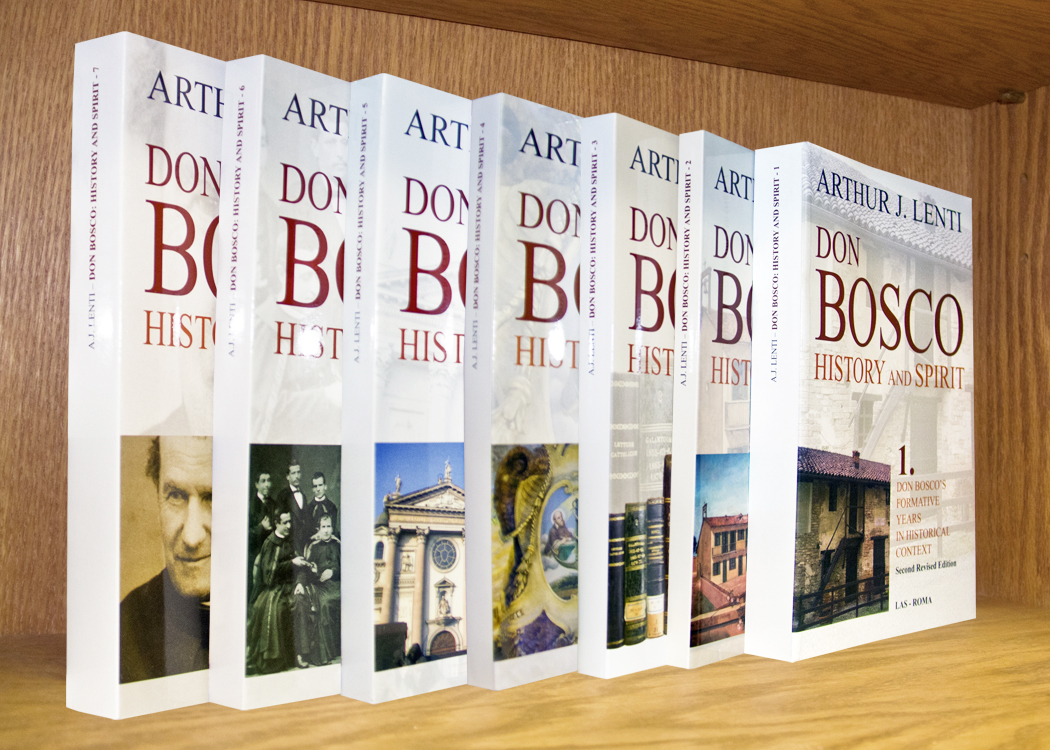
Fr. Arthur Lenti’s Don Bosco History and Spirit offers an in-depth survey of the life and times of John Melchior Bosco (Familiarly known as “Don Bosco”). Each of the seven volume takes a close look at a particular time period of his life:
Each volume may be purchased individually at full price, or they may be purchased in a set at a discounted price.
- Vol 1: John Bosco’s Formative Years in Historical Context
- Vol 2: Birth and Early Development of Don Bosco’s Oratory
- Vol 3: Don Bosco Educator, Spiritual Master, Writer and Founder of the Salesian Society
- Vol 4: Beginnings of the Salesian Society and Its Constitutions
- Vol 5: Institutional Expansion
- Vol 6: Expansion of the Salesian Work in the New World and Ecclesiological Confrontation at Home
- Vol 7: Don Bosco’s Golden Years
Detail:
The first three volumes survey the up to 1864, with particular attention to nineteenth-century political, social and religious history. This survey looks at Don Bosco’s own education, at his spiritual and theological formation leading to his priestly ordination (1841). It discusses his vocational choices and his work on behalf of poor young people at risk, as well as his subsequent expanded apostolic commitments, especially in the field of education. It examines the growth of the work, and the founding and initial development of the Society of St. Francis de Sales created to continue that work, in the context of the liberal revolution and the unification of Italy (1848-1861).
The next four volumes describes Don Bosco’s life and work in the period following the unification of Italy, a period marked by epochal changes in Italian society. In this setting Don Bosco, History and Spirit discusses the institutional developments and organization of the Salesian Society through the stages of the approval of the institute and of the constitutions by the Holy See. It describes Don Bosco’s further ministerial choices, especially in the field of education, and his further founding work. It surveys the expansion of the Salesian work to parts of Italy and to European and South American countries. At the same time it examines the development of permanent structures to guarantee the continuance of the Salesian work, and discusses some of the founder’s insights and ideas, especially as they emerge from the reflective writings of his maturity.